Let me begin by asking why Ethiopia is currently using ethnic-based federalism? What is its relevance of advocating for ethnicity? Do you think that is a political reason? For me, yes, the government, the political power holders who are sitting on the throne and pursuing their indulgent life, do not like people’s unity. Remember the proverb “United we stand, divided we fall.” of course the it seems like that political power holders needs it to sustain their life time on power. What are the unfolding problems that Ethiopia is facing?

The 1995 FDRE Constitution justified the incorporation of ethnic federalism at the time of its enactment as an attempt to manage the country’s ethnic diversity. However, the silliest part of the constitution is that it does not directly confer the rights to individuals; rather, you are supposed to be a part of a certain nation or nationality to exercise any kind of right mentioned under the constitution. The preamble says that: “we the nations and nationalities…”, from this stipulation, you can easily understand that the ultimate political power is granted to the groups. Further, it includes the unique right which is uncommon in almost all of the world’s countries’ constitutions; this unique right has mentioned under article 39 of the constitution, nations, nationalities, and peoples also have the right to self-governance, including the right to secede. While the system was basically intended to correct what had been said historical injustices and empower marginalized groups, it has instead fostered division, violence, and political instability. This essay critiques ethnic federalism in Ethiopia, showing how it has institutionalized ethnic identity, exacerbated conflict, undermined democracy, and weakened national unity. And also, I would like to argue for the urgent abolition of this system and the adoption of any other, i.e., a geographical-based federal structure. The following reasons could be the first footsteps against arguments ethnic based structure.
It prioritizes Ethnic Identity over citizenship
Ethnic federalism emphasizes ethnic identity over national citizenship, thus weakening the sense of belonging to a unified Ethiopian nation. Regional states are delineated according to dominant ethnic groups, and practically speaking, citizens are identified by their first ethnicity rather than nationality. This structure has encouraged ethno-nationalist sentiment and discouraged cross-cultural integration (Asnake, 2013).
Proliferation of Ethnic Conflict and Obstruction to Democratic Governance
Far from resolving ethnic grievances, ethnic federalism has escalated ethnic tensions and conflicts. The establishment of ethnically homogeneous regions with distinct security forces has turned political disputes into violent confrontations. According to a report by ACCORD (2021), the system has “sharpened boundaries among the different ethnic groups” and led to large-scale internal displacement and recurring ethnic violence.
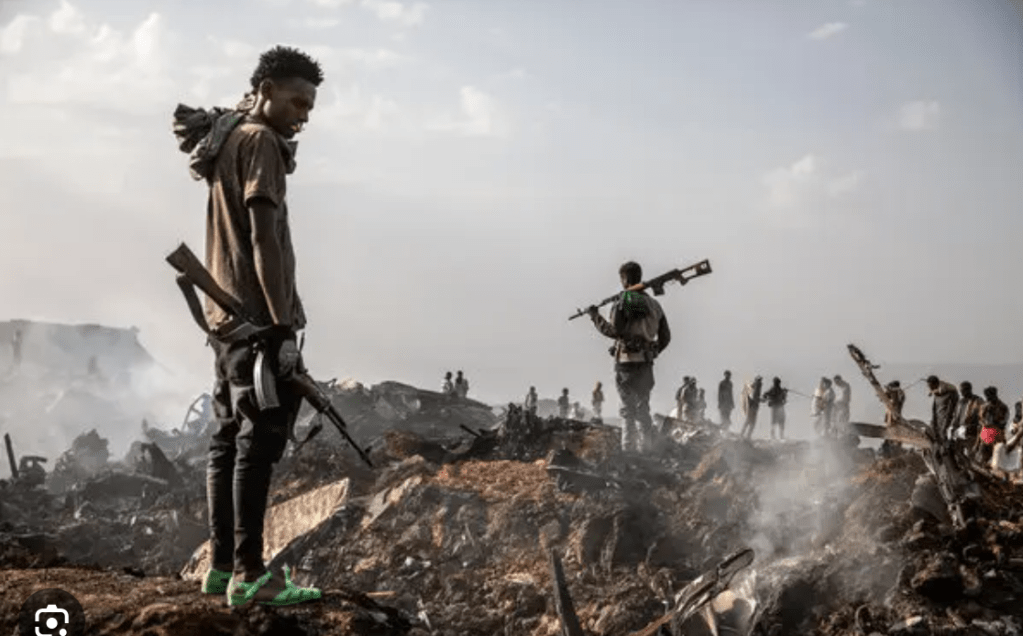
On the other hand, rather than promoting inclusive governance, ethnic federalism has entrenched the power of ethnic elites and reduced democratic competition. Political parties are often ethnically based, which limits cross-regional political engagement and encourages exclusionary practices. According to Fessha & Gebregziabher, 2021, this has “undermined the prospects for democratic consolidation.”
It is a Threat to National Integrity and an Impediment to Development
Article 39 of the constitution, granting ethnic groups the right to secede, has made the country’s territorial integrity precarious. It encourages separatist movements and deters long-term state-building efforts. In the most recent northern conflict between the central government and the TPLF, this provision was a central point of contention, which shows us its destabilizing potential (Abbink, 2011).
Plus to that, looking from the point of development view, Ethnic federalism has no contribution; it hampers national development efforts due to fragmented governance, duplication of corrupted administrative structures, and inter-regional distrust. The obvious fact is that coordinated economic policies are difficult to implement in such a system where regions prioritize ethnic interests over national goals (Záhořík, 2014). The result is uneven development and persistent poverty.
Reference
Abbink, J. (2011). Ethnic-based federalism and ethnicity in Ethiopia: Reassessing the experiment after 20 years. Journal of Eastern African Studies, 5(4), 596–618.
ACCORD. (2021). Ethnic conflict under ethnic federalism in Ethiopia. African Centre for the Constructive Resolution of Disputes.
Asnake, K. (2013). Federalism and ethnic conflict in Ethiopia: A comparative regional study. Routledge.
Fessha, Y., & Gebregziabher, H. T. (2021). Is constitutional design the cause of ethnic conflicts in Africa? A comparative study of Ethiopia and Kenya. India Quarterly, 77(4), 519–535.
Záhořík, J. (2014). The Horn of Africa: Intra-state and inter-state conflicts and security. International Journal of African Renaissance Studies, 9(1), 114–130.

 Habesha Law